
How Material Choice Affects Stamped Part Performance
Material selection plays a major role in how stamped metal parts perform, last, and fit into an overall assembly. As a global metal stamping manufacturer, we work closely with our customers to identify the right material to improve strength, reduce waste, and simplify part finishing across deep draw metal forming, progressive die stamping, and transfer press stamping applications.
Here are a few key factors that show how material choice can influence performance, manufacturability, and long-term value.
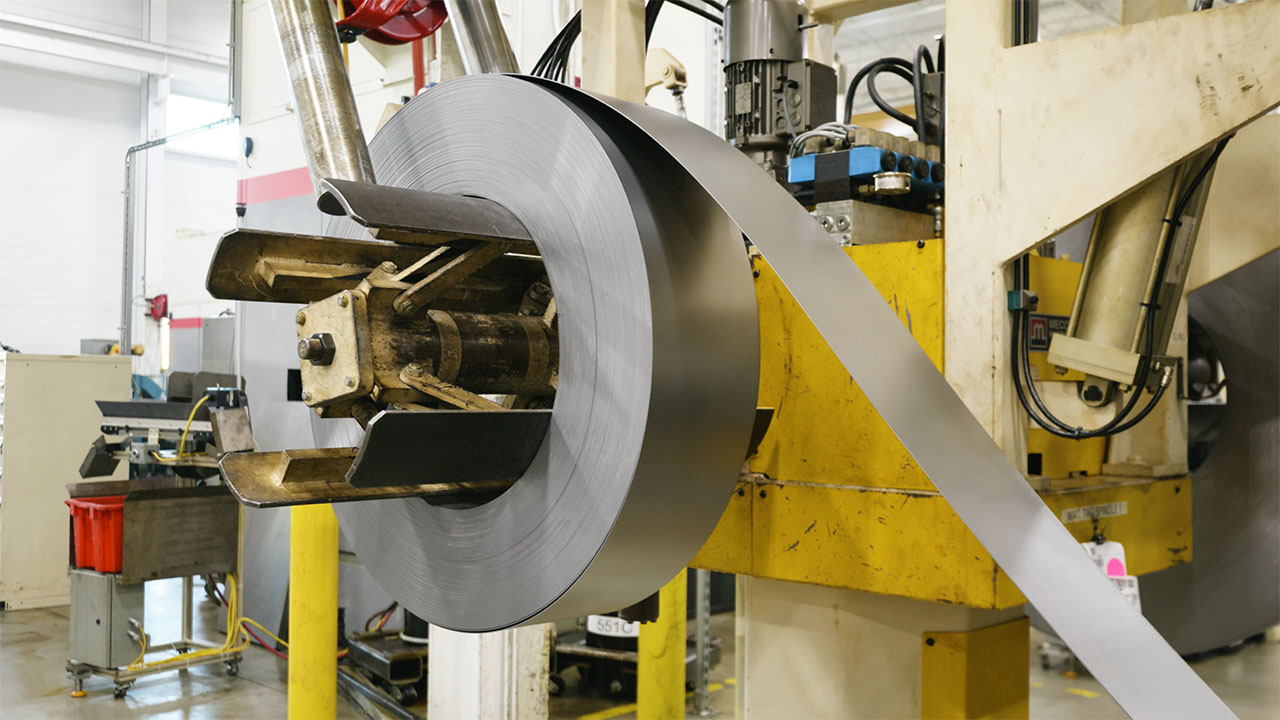
Formability & the Metal Forming Process
Formability determines how well a material responds to shaping without tearing, wrinkling, or thinning. Deep draw forming materials such as low carbon steel, aluminum, and certain stainless steels are commonly used when parts require significant depth or complex geometry. Deep drawn metal stampings depend on consistent material flow, which is why ductility and grain structure matter early in the forming process.
Progressive die and transfer press stamped parts also rely on predictable forming behavior. Progressive die stamping often benefits from materials that can handle repeated bends and punches across multiple stations. Transfer press stamping, on the other hand, is ideal for larger or deeper components where the material must hold its shape through each transfer.
Matching the material to the forming method helps maintain stamping standards and reduces tool wear.
Strength, Weight, & Performance Requirements
Performance requirements often drive material decisions. Automotive, EV, and alternative energy applications may need a balance of strength and weight. Deep drawn aluminum stampings are popular when weight reduction is critical, while still providing good corrosion resistance. For higher strength-to-weight ratios, deep drawn titanium parts offer excellent durability, though they require more control during forming.
Stainless steel stamped parts are frequently used where corrosion resistance and structural strength are essential, such as HVAC or plumbing systems. Low carbon steel remains a cost-effective option for many stamped metal parts that need strength without added material expense. Choosing the right balance between strength, weight, and cost ensures parts meet functional demands without overengineering.
Conductivity, Corrosion Resistance, & Specialized Uses
Certain applications depend heavily on conductivity or resistance to harsh environments. Copper stamped parts and brass stampings are common in electrical and thermal applications due to their excellent conductivity and ease of forming. Stamped bronze parts are often selected for wear resistance and performance in moving assemblies.
Environmental exposure also plays a role. Stainless steel, aluminum, and titanium resist corrosion in demanding conditions, reducing the need for additional coatings. When part finishing is required, material choice affects plating adhesion, surface appearance, and long-term durability. Selecting materials that naturally support the end-use environment can simplify finishing steps and extend part life.
Manufacturing Limits, Tolerances, & Prototyping
Material thickness and part size directly influence manufacturing feasibility. As a deep draw forming company, we work with raw materials up to 0.180” (4.5mm) thick to produce parts up to 10.6” (270mm) long. This requires careful alignment between material properties and tooling design. Some metals handle thicker gauges well, while others perform better at lighter thicknesses.
Early collaboration and custom prototyping services help validate material choices before full production. Prototypes reveal how each forming process will affect tolerances, surface quality, and repeatability. This step reduces risk and ensures custom metal formed parts meet expectations across industries such as lawn equipment, HVAC, and automotive manufacturing.
Let’s Talk Part Materials
No single material works for every stamped part. As a global metal stamping company, we know the best results come from aligning application needs, forming methods, and performance goals. Together, we help create reliable, efficient, and cost-effective stamped metal parts that perform exactly as intended. Ready to get started with Trans-Matic? Fill out our online contact form today to schedule a consultation.
