
Progressive Die Stamping FAQ
Progressive die stamping is one of the workhorses of high-volume metal manufacturing. A single die, a coil of steel, and a feeding system that never stops moving can turn out thousands of identical parts a day, which is why it shows up everywhere from automotive brackets to HVAC housings.
As a global metal stamping company, we've built progressive die stamping into a core part of how parts move from raw coil to finished product for automotive, electric vehicle, lawn equipment, and plumbing manufacturers.
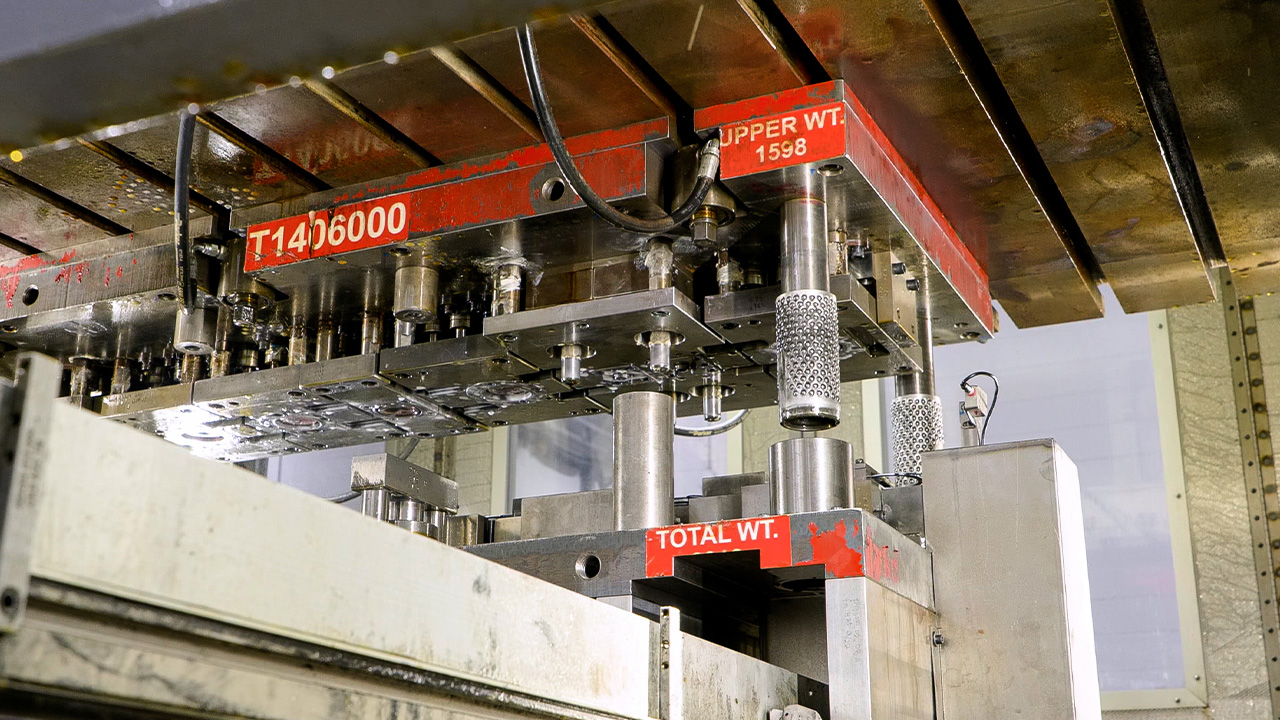
Here's what you need to know about this form of custom metal stamping.
How Does the Progressive Die Stamping Process Work?
A coil of metal feeds automatically into the first station, and the strip advances a fixed distance after every stroke. Each station downstream performs its own operation until the last station cuts the finished part free.
At Trans-Matic, we run 15 progressive die presses globally ranging from 60 to 500 tons of capacity. Bullet-shaped pilots enter previously pierced holes in the strip at each station, which keeps alignment accurate to a few thousandths of an inch as the strip moves.
What Types of Parts Can Progressive Die Stamping Produce?
Progressive die stamping handles both flat stampings and parts that need a deeper draw, which covers most small-to-midsize components used in high-volume assemblies. Automotive brackets, connectors, lawn equipment hardware, and plumbing and HVAC fittings are common examples.
Material choice plays a big role in how those stamped metal parts perform once they're in the field, from fatigue resistance to how well they hold a finish. That's usually decided alongside the die design, not after it.
What Materials Work Best for Progressive Die Stamping?
Low carbon steel is the most common choice when it comes to metal forming materials, as it’s prized for its formability, strength-to-weight ratio, and cost. Stainless steel, aluminum, titanium, brass, copper, and bronze all run through progressive dies too, depending on what the finished part needs to do.
At Trans-Matic, we process raw material up to 0.180 inches thick for these programs.
Materials commonly run through progressive dies include:
- Low carbon steel, for high-volume, cost-sensitive parts
- Stainless steel, where corrosion resistance and strength matter
- Aluminum, for lightweight parts in power storage or battery applications
- Titanium, brass, copper, and bronze, for specialized strength, conductivity, or corrosion needs
How Is Progressive Stamping Different From Transfer Press Stamping?
Progressive die stamping runs a continuous strip through a single die and suits simple-to-moderate part geometries in thin-to-medium materials at high volume. It's the more economical choice for long production runs.
Transfer press stamping loads individual pre-cut blanks and moves them between stations across multiple dies, which is better suited to larger, more complex, deep-drawn parts. Both methods sit under the broader umbrella of metal forming, and the right one depends on part size, complexity, and volume, not a single "better" option.
What Are the Benefits of Progressive Die Stamping?
The biggest advantage is speed at volume: a single die produces a finished part on every stroke, with minimal scrap and low labor input per part. High part-to-part repeatability also means uniform quality across a full production run, not just the first batch off the press.
Progressive die stamping allows for:
- Fast setup and quick changeover between runs
- Minimal scrap thanks to tight strip nesting
- Lower labor cost per part than processes requiring manual handling between stations
- Consistent quality across thousands, or millions, of identical metal stampings
How Fast Can Progressive Die Presses Run?
Speed depends on the part and the tooling, but our progressive stamping presses run at up to 250 strokes per minute. Output ranges from as few as 7 or 8 parts per minute on more complex parts up to 1,500 parts per minute on simpler ones.
That range is exactly why progressive die stamping fits high-volume programs so well. A single press can run for an entire shift without slowing down, and the part coming off the die at minute 400 looks the same as the one at minute one.
Can Progressive Die Stamping Support Custom Prototyping?
Yes. Progressive die programs almost always start with prototyping, since tooling built around an unproven design is expensive to fix later.
Our custom prototyping services take a part from a rough sketch or CAD file through 3D visualization and feasibility analysis before any production tooling gets cut.
Finite element analysis and rapid stereolithography catch design issues early, before they turn into a die that has to be reworked mid-production. Two in-house tooling rooms let our team move from prototype feedback to adjusted tooling without waiting on an outside vendor, through the same product development and prototyping team that builds the final production dies.
Why Does Precision Matter in Progressive Metal Stamping?
Because a progressive die runs the same operation thousands of times in a row, even a small tolerance drift compounds fast. Precision metal stamping depends on pilots holding strip alignment to a few thousandths of an inch at every single station, every single stroke.
That precision matters most in applications like automotive and electric vehicle components, where a part that's slightly out of spec can affect how an assembly fits or performs downstream. It's also what makes high part-to-part repeatability possible in the first place, rather than a happy accident of a well-tuned press.
Connect With Our Team Today
As a global metal stamping manufacturer, we have the tooling, materials expertise, and press capacity to take on the next production run. Ready to get started with Trans-Matic? Fill out our online contact form today to schedule a consultation.
